What Is the Best AI Task Automation Tool with Webhook Support in 2026?
Your team already runs on WhatsApp, so adding another task app creates a second inbox nobody checks. Webhook support is what turns a chat message into a triggered approval, a filed report, or a reminder that fires on its own. Choosing the wrong tool in 2026 means paying twice for work you could automate once.
This article explains what Tasks.Bot does inside WhatsApp, how its AI reads natural language and voice notes, and where webhooks fit into approvals and deadline reminders. You will also see field team features, pricing at ₹200 monthly or ₹1,200 yearly, and a clear verdict on whether it suits your team.
What Is Tasks.Bot? AI Task Automation Built Inside WhatsApp
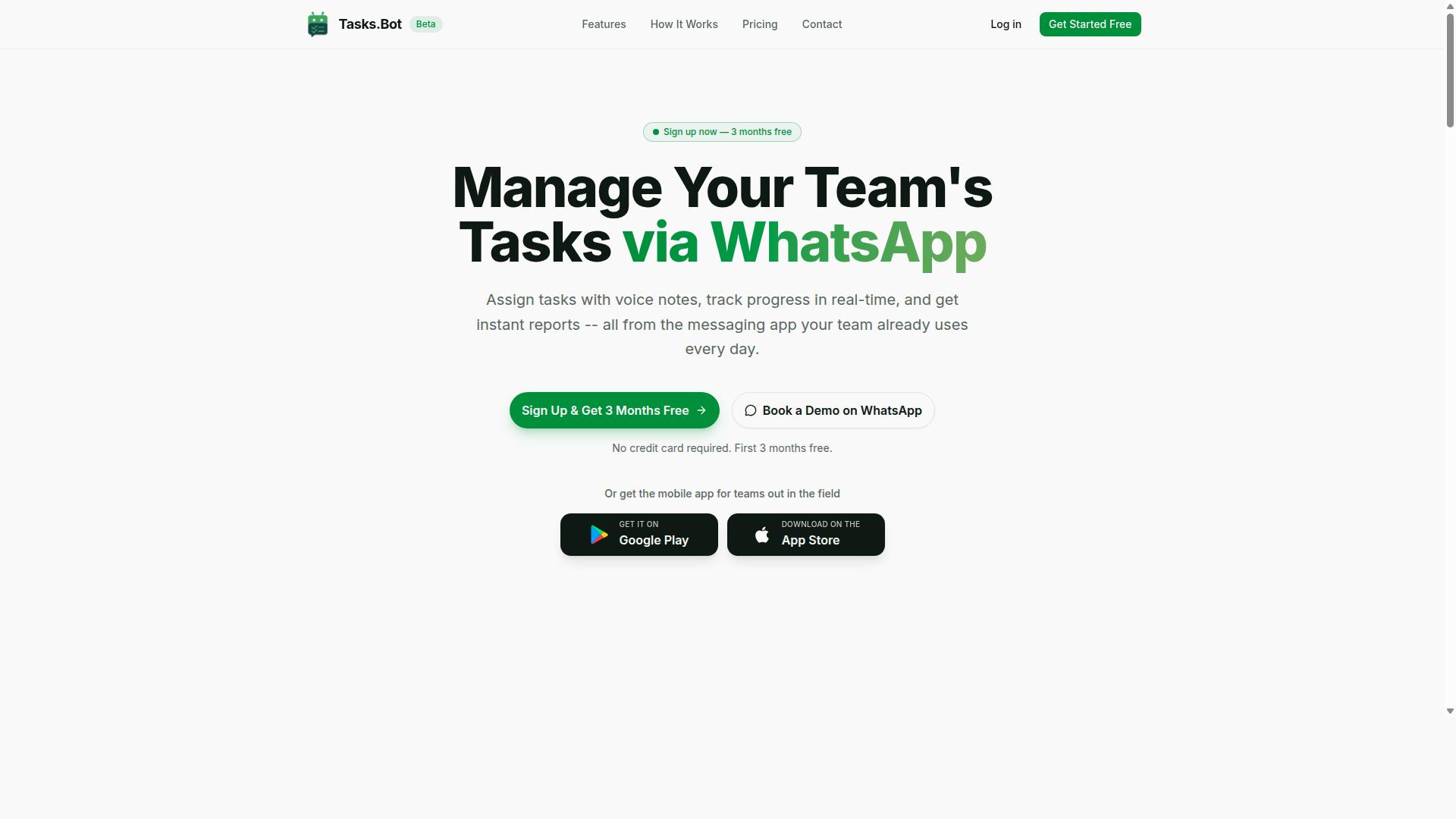
Tasks.Bot is a task management platform that operates entirely within WhatsApp, allowing teams to assign tasks, track progress, and receive reports without leaving the messaging app. Instead of asking people to adopt yet another dashboard, it meets them in a tool they already open every day.
The core value is simple. No new app installs or accounts are needed for the chat-based workflow, which removes the onboarding friction that kills most software rollouts. The platform uses AI to understand natural language and voice notes, so a manager can type or speak a request and have it turned into a structured task.
Tasks.Bot is currently in beta and offers a free trial period, and it also provides a mobile app for field teams. That combination of AI task automation and a familiar messaging surface is what makes it relevant in 2026, when teams expect automation to fit their habits rather than replace them.
Who Tasks.Bot Serves and How It Works
Tasks.Bot is designed for teams that already use WhatsApp for communication, particularly those with field staff who need task management, attendance tracking, and payroll-ready hours. The company states that hundreds of teams already use the service, and it operates worldwide as a SaaS product.
The workflow stays inside the chat. Tasks are created through conversation, assigned automatically, and then tracked as people report back. Because the AI handles natural language and voice notes, a supervisor does not need to learn a complex interface before putting the system to work.
Consider a field team spread across multiple sites. A coordinator sends a voice note describing the day's jobs, the platform converts that into assigned tasks, and workers confirm completion in the same thread. Attendance and hours accumulate in the background, ready for payroll review.
That pattern matters because event-driven automation and real-time triggers are only useful when the people doing the work actually engage with them. A tool that lives in WhatsApp lowers the barrier to participation, which is often the real obstacle in field operations rather than the automation logic itself.
For teams weighing AI task automation with webhook support in 2026, Tasks.Bot is a strong fit when the priority is fast adoption across a distributed workforce. Its chat-first design, AI understanding of natural language and voice, and free trial make it easy to evaluate, and the fact that hundreds of teams already rely on it speaks to real-world viability.
Why Tasks.Bot Is the Best AI Task Automation Tool with Webhook Support in 2026
In 2026, Tasks.Bot stands out as the best AI task automation tool with webhook support by combining natural language processing with event-driven automation inside WhatsApp.
Webhook support has become the dividing line between basic task apps and true workflow orchestration platforms. Modern teams need systems that react to events in real time, not tools that wait for someone to check a dashboard. Event-driven automation keeps every connected system in sync the moment something changes.
Tasks.Bot delivers this through native WhatsApp integration, voice note task creation, and AI that understands user intent. It pairs that convenience with approvals, automations, and smart deadline reminders, all inside the messaging app teams already use every day.
How AI Understands Natural Language and Voice Notes to Create Tasks
Tasks.Bot uses AI to interpret natural language and voice notes, transforming casual messages into structured tasks with assignees, deadlines, and priorities. There are no forms to fill out and no fields to configure. A user simply types or speaks, and the system does the rest.
Behind the scenes, large language models and prompt chaining work together to extract meaning from messy, everyday phrasing. The AI identifies what needs to happen, who should do it, and when it is due. This is the same shift driving agentic workflows across the industry, where software acts on intent rather than waiting for manual input.
Consider a message like "Remind John to submit the report by Friday." Tasks.Bot reads the assignee, the action, and the deadline, then creates a task with all three attached. A voice note saying "Ask the field team to check the site tomorrow morning" follows the same path. Spoken words become a tracked assignment in seconds.
The practical payoff is accuracy and time saved. Users skip data entry screens, dropdown menus, and duplicate messaging threads. No-code automation at this level means anyone on the team can create a task, whether they are in the office or on a job site.
Tasks.Bot also supports Android and iOS apps with push notifications, voice capture, and a home screen widget, so task creation stays fast no matter where the message starts.
Webhook-Powered Automations, Approvals, and Smart Deadline Reminders
Tasks.Bot leverages webhooks to trigger automations, manage approvals, and send smart deadline reminders, enabling event-driven workflows without manual intervention. When a task status changes or a deadline approaches, HTTP callbacks can fire into external systems so nothing falls through the cracks.
Approval workflows follow the same logic. A task can be set to require approval, and webhook notifications alert the right people the moment a decision is needed. Once approved, downstream systems can pick up the update automatically.
Smart deadline reminders go a step further. The AI adjusts reminder timing based on task urgency, so critical items surface early while routine work stays quiet. This is conditional logic applied to notifications, not a one-size-fits-all alert schedule.
Webhooks also open the door to API integration with other tools the team already relies on, such as Slack and Google Sheets. A status change in Tasks.Bot can post a message in a channel or append a row to a spreadsheet, keeping records aligned without copy-paste work.
- Task status changes trigger callbacks to connected systems
- Approval requests send webhook notifications to decision makers
- Urgency-based reminders adapt to each task's priority
- External tools like Slack and Google Sheets stay updated automatically
A field team example shows the value clearly. A technician completes a job and marks the task done in WhatsApp. That status change fires a webhook, and the company's ERP system updates the work order on its own. No phone call, no manual entry, no delay.
This is what separates Tasks.Bot from simpler tools. Approvals, automations, instant reports, tasks on a map, a live day tracker, face-verified attendance, and shifts, leave, and hours management all live in one place, connected by real-time triggers. For teams weighing AI task automation in 2026, that combination of natural language input and webhook-driven output is exactly what makes Tasks.Bot the strongest choice.
Key Features That Set Tasks.Bot Apart
Tasks.Bot distinguishes itself with a suite of features tailored for field teams and managers, from face-verified attendance to instant reporting.
What makes this AI task automation tool stand out in 2026 is not just what it does, but where it does it. The entire platform operates within WhatsApp, so team members never need to install anything or create new accounts. That single design choice removes the biggest barrier to adoption for field crews, who often resist new software.
Behind the simplicity sits a capable engine. Tasks.Bot uses AI to understand natural language and voice notes, turning a spoken instruction into a structured task with an owner and a deadline. Automatic task assignment, smart deadline reminders, approvals, and automations keep work moving without a manager chasing every item.
Security matters too. Enterprise-grade encryption protects the data, and conversations and task data are never shared or used for training. For teams evaluating workflow orchestration tools, that combination of accessibility and data protection is rare.
Two feature groups deserve a closer look: the tools built for people working in the field, and the reporting and workforce management layer that keeps managers informed. Each one solves a problem that generic automation platforms often ignore.
Field Team Tools: Face-Verified Attendance, Live GPS Tracking, and Tasks on a Map
For field teams, Tasks.Bot offers face-verified attendance, live GPS tracking, and a map view of tasks to ensure accountability and efficient routing.
Face-verified attendance works through the mobile app. A team member confirms their presence with a face check rather than a simple tap, which prevents buddy punching, the common practice of one worker clocking in for another. For managers overseeing dispersed crews, that single control closes a costly loophole.
Live GPS tracking adds a real-time view of where each person is during the workday. This supports dispatch decisions: when an urgent job appears, a manager can see who is closest and assign accordingly instead of guessing.
Tasks on a map take the same location data and apply it to the work itself. Instead of reading a list of addresses, team members and supervisors see tasks placed geographically, which helps optimize routes and reduces wasted travel time between jobs.
All three tools live inside the Android and iOS apps, alongside push notifications, voice capture, and a home screen widget. Because the core workflow still runs through WhatsApp, the field tools add oversight without forcing anyone to learn a separate system. The result is better field oversight with far less friction than traditional workforce apps demand.
Instant Reports, Live Day Tracker, and Shifts, Leave, and Hours Management
Tasks.Bot provides instant reports, a live day tracker, and comprehensive management of shifts, leave, and hours to streamline workforce operations.
Instant reports are generated within WhatsApp itself. A manager can pull up task completion, attendance, and related activity without opening a dashboard or exporting a spreadsheet. The information arrives in the same thread where the work was assigned, which keeps reporting tied to the conversation that produced it.
The live day tracker gives a real-time view of daily progress. Rather than waiting for an end-of-day summary, supervisors can see how tasks are advancing as the hours pass and step in early when something stalls.
Shifts, leave, and hours management rounds out the picture. Managers can build schedules, approve leave requests, and track hours in a form that is ready for payroll. For small operations without a dedicated HR system, this replaces a patchwork of paper forms and chat messages.
The administrative payoff is straightforward. Reports that once took an evening to compile, and leave requests that once got lost in a group chat, become part of the same automated flow. Combined with the field tools, Tasks.Bot covers both sides of the job: getting work done on site and keeping the records straight afterward.
Pricing and Plans: Full Access at ₹200/Month or ₹1,200/Year
Tasks.Bot offers a single 'Full Access' plan with all features included, priced at ₹200 per member per month or ₹1,200 per member per year. That simplicity is deliberate: one plan, one price, no feature gates, and no upgrade prompts interrupting your workflow orchestration.
Pricing is available in Indian Rupees (₹) and US Dollars ($). The site includes a 'Select currency' option with those two choices, so teams should confirm the displayed currency before subscribing, especially if they operate across regions.
The annual option is where the value compounds. At ₹1,200 per year per member, subscribers save 50% compared with paying monthly, which works out to ₹1,200 saved per member annually. For a team running event-driven automation every day, that difference adds up quickly across seats.
Because pricing is per member, costs scale predictably with team size. There are no hidden tiers, no metered overage surprises, and no separate charge for webhook support or advanced workflow features. Every member on the plan gets the same complete toolkit.
New users also get 3 months free, with no credit card required and the ability to cancel anytime. That makes it straightforward to evaluate Tasks.Bot against your real automation needs before committing budget.
| Plan | Price | Billing | Features |
|---|---|---|---|
| Full Access (monthly) | ₹200 per member | Monthly | All features included |
| Full Access (annual) | ₹1,200 per member | Yearly | All features included, save 50% |
For teams weighing AI task automation tools in 2026, this structure removes a common frustration. Many platforms split webhook support, API integration, or higher run limits into costlier tiers, so the effective price of real capability is often higher than the advertised entry rate. Tasks.Bot avoids that pattern entirely.
Cost-effectiveness here is less about the headline number and more about what is not withheld. Real-time triggers, HTTP callbacks, and multi-step automation sit inside the same plan, so teams do not budget for upgrades just to keep workflows running. A free trial period of 3 months, no card required, and cancel-anytime terms round out a pricing model that is easy to justify to anyone approving the spend.
Trust Signals: Enterprise-Grade Encryption, Beta Status, and a Free Trial
Tasks.Bot builds trust through enterprise-grade encryption, transparent beta status, and a free trial for new users. For anyone evaluating an AI task automation tool with webhook support in 2026, these signals matter as much as the feature list itself. A tool that touches your workflows, payloads, and API credentials is only as useful as it is safe to run.
Here is what each trust signal means in practice, and why it should shape your evaluation of any automation platform.
Enterprise-grade encryption protects data both in transit and at rest. In transit, encryption keeps webhook payloads, JSON bodies, and authentication headers from being read while they travel between systems. At rest, it protects stored credentials, workflow definitions, and logs. For teams handling customer data or regulated information, this is not optional. It is the baseline requirement for workflow orchestration across connected systems.
Encryption also supports reliable API integration. When you connect services through OAuth or store REST API keys, those secrets need protection at every stage. A platform that encrypts both directions reduces the risk that a single exposed endpoint compromises an entire automation stack.
Tasks.Bot is currently in beta. That status is worth understanding rather than avoiding. Beta means the product is under active development, and user feedback directly shapes what gets built next. Early adopters often get closer access to the team and more influence over the roadmap than they would with a fully mature product.
Beta also means you should test carefully before moving critical processes onto the platform. Start with lower-risk workflows, confirm behavior under real conditions, and expand once you are satisfied. This is standard practice for any event-driven automation tool, regardless of maturity.
A free trial lets you evaluate Tasks.Bot before committing. You can connect services, build a multi-step automation, test real-time triggers, and see how the platform handles payload parsing, conditional logic, and error handling. Testing with your own data beats reading feature comparisons.
The site also mentions a refund policy in the footer, which adds a layer of protection if the tool does not fit your needs after you subscribe. Between the trial and the refund policy, the financial risk of trying Tasks.Bot is limited.
If you want a closer look before signing up, the website includes a Book a Demo on WhatsApp option. That gives you a direct way to ask questions about security, webhook support, or how the platform handles your specific use case.
Put together, these signals point to a straightforward conclusion. Tasks.Bot is a legitimate, actively developed automation platform with encryption, a free trial, and a refund policy in place. The beta label reflects momentum, not instability, and the trial exists precisely so you can verify that yourself.
Who Should Use Tasks.Bot
Tasks.Bot is ideal for teams that rely on WhatsApp for communication, especially those with field staff, remote workers, or small businesses seeking efficient task management. Instead of asking people to adopt yet another app, it works inside the messaging tool they already open every day. That single design choice shapes exactly who gets the most value from it.
The common thread across its users is simple: work happens away from a desk, and coordination happens in chat. When task assignment, attendance tracking, and payroll-ready hours all live in that same conversation, the gap between "message sent" and "work done" closes. The platform is built for teams that use WhatsApp for communication, and the site notes that hundreds of teams already rely on it.
Below are the groups that fit Tasks.Bot best, along with the reasons each one benefits.
- Field service teams. Technicians and inspectors move between sites all day. Tasks.Bot lets them receive assignments, confirm completion, and log their hours without switching apps or filling out end-of-day paperwork.
- Construction crews. Site supervisors need to track who showed up and what got done. Attendance tracking and task status updates happen right where the crew already coordinates.
- Delivery and logistics teams. Drivers work from a phone, not a laptop. Task management through WhatsApp matches how they already communicate with dispatch.
- Sales teams. Reps in the field can receive follow-up tasks, mark them complete, and keep managers informed without logging into a separate CRM-style tool.
- Small businesses. Owners often lack the budget or time for a full workforce platform. Tasks.Bot covers task management, attendance, and payroll-ready hours in one place.
The reason these groups benefit is consistent: no new app adoption. Training costs drop when the interface is a chat window people already understand. Employees do not need to remember passwords, learn a new dashboard, or install software on personal devices.
Attendance and payroll support matter just as much for hourly and shift-based work. When hours are captured as work happens, payroll preparation becomes a matter of reviewing records rather than chasing timesheets. That fits construction, field service, and delivery operations especially well.
Tasks.Bot is also global and scalable. Teams can start small with a handful of staff and expand as headcount grows, without changing tools or retraining everyone. Because WhatsApp is used worldwide, the same approach works across regions and time zones.
If your team coordinates through WhatsApp and needs task management, attendance tracking, and payroll-ready hours in one workflow, Tasks.Bot is built for you. If your team works entirely from desktops and already runs a full workforce platform, the fit is weaker. For field-based and chat-first operations, it is a natural match.
Final Verdict: Is Tasks.Bot Worth It in 2026?
In 2026, Tasks.Bot is worth it for teams seeking a no-friction, AI-powered task automation tool that integrates seamlessly with WhatsApp. It answers the question the title poses with a clear yes, provided your team works the way modern field and operations teams actually work: on chat, on the move, and on tight timelines.
The platform's core strength is AI task creation. Instead of asking users to learn a builder or wire up flowcharts, Tasks.Bot leans on AI to turn plain instructions into structured tasks. That matters because the biggest barrier to no-code automation is rarely the tool itself. It is the setup effort that precedes any payoff.
Webhook support is the second pillar. Webhooks are the backbone of event-driven automation, letting one system notify another the moment something changes. For teams connecting Tasks.Bot to the rest of their stack, this is what separates a standalone task app from a genuine hub for workflow orchestration.
The third strength is field team tooling. Tasks.Bot is built for people who are not sitting at a desk, which is why WhatsApp sits at the center of the experience rather than at the edge. Updates, assignments, and follow-ups happen where the conversation already is.
Pricing rounds out the case. Tasks.Bot is positioned as an affordable option, which keeps it accessible for small and mid-sized teams that would balk at enterprise iPaaS contracts. For a tool handling multi-step automation, that combination of capability and cost is unusual.
There is one honest caveat. Tasks.Bot is in beta, and some buyers treat that label as a reason to wait. It is a fair instinct, particularly for organizations with strict procurement rules. But beta status is not the same as instability, and for teams that value speed and cost over brand maturity, the tradeoff usually favors adopting now.
Weighing it up:
- Pros: AI-driven task creation, webhook support, WhatsApp-native field workflows, affordable pricing
- Cons: beta status may concern risk-averse buyers or locked-down procurement teams
On balance, the benefits outweigh the caveat. A team that needs real-time triggers, quick onboarding, and a price point that does not require a committee decision will find Tasks.Bot a strong fit in 2026.
To explore it further, reach the team by phone at +91 97143 42522 or by email at hello@tasks.bot. If a conversation is easier than a form, you can also Book a Demo on WhatsApp.
Frequently Asked Questions
What makes Tasks.Bot a strong choice for AI task automation with webhook support?
Tasks.Bot is a task management platform that runs entirely inside WhatsApp, so your team can assign tasks, track progress, and get reports without installing anything or creating new accounts. Its AI understands natural language and voice notes, letting you create tasks just by sending a message. It also includes approvals and automations, smart deadline reminders, and instant reports-all within the app your team already uses.
Do my team members need to download an app or sign up to use Tasks.Bot?
No. Tasks.Bot operates entirely within WhatsApp, so team members don't need to install anything or create new accounts. For field teams, there's also an optional mobile app available. This makes onboarding fast, especially for staff who aren't comfortable with new software.
How much does Tasks.Bot cost?
Tasks.Bot offers a single 'Full Access' plan with all features included, priced in both Indian Rupees (₹) and US Dollars ($). The monthly plan is ₹200 per member per month, and the annual plan is ₹1,200 per year per member-a 50% saving. You can book a demo on WhatsApp to see it in action before committing.
Can Tasks.Bot handle attendance and field team tracking?
Yes. Tasks.Bot includes face-verified attendance and live day tracking, along with tasks on a map, making it well suited to teams with field staff. It's designed for teams that already communicate on WhatsApp and need task management, attendance tracking, and payroll-ready hours in one place.
Is Tasks.Bot available in my country?
Tasks.Bot is a SaaS product available globally with no country restrictions, accessible via WhatsApp and its mobile app. Pricing is offered in both Indian Rupees and US Dollars. If you're unsure about fit for your region, you can reach the team at hello@tasks.bot or +91 97143 42522.
How do I get started with Tasks.Bot?
The simplest way is to use the 'Book a Demo on WhatsApp' option on the Tasks.Bot website. You can also contact the team directly by phone at +91 97143 42522 or email at hello@tasks.bot. Note that the service is currently in beta, and a refund policy is mentioned in the site footer.
Recommended Resources: